





DIGITAL BOOK | A PERSONAL JOURNEY THROUGH AQUAPONICS
My Invisible Therapist
Finding Calm, Connection and a Place to Breathe Through Aquaponics
Sometimes the thing that helps us find our way forward isn't what we expected.
For me, it was aquaponics.
My Invisible Therapist is the deeply personal story of how growing food, caring for fish and learning to understand a living ecosystem became part of my journey through trauma, depression and anxiety.
Aquaponics gave me something practical to focus on when my thoughts were overwhelming. It gave me healthy food when food security mattered.
It gave me somewhere to breathe, something to learn and a reason to keep moving forward.
This isn't a book promising that aquaponics will heal everyone.
It's simply my story of how it helped me.
Digital Book · $7 USD · Instant Access


When Aquaponics Became More Than Growing Food
I originally turned to aquaponics for very practical reasons.
I wanted healthy food. I wanted greater food security. I wanted to become more self-sufficient.
At the same time, my life was being consumed by trauma, anxiety, depression and experiences from my past that I was trying desperately to understand.
Then my first aquaponics system failed.
The fish died. The plants weren't growing. And on a freezing, wet winter day, I sat beside that failed system completely overwhelmed by the feeling that I hadn't simply failed at aquaponics.
I had failed at life.
I didn't know then that this failure would send me looking for answers, into aquaculture and eventually much deeper into understanding aquaponics.
And somewhere along the way, learning how to care for that ecosystem began teaching me something about how to care for myself.
A Place to Breathe
There were times when the thoughts inside my head felt impossible to quiet.
But something changed when I went outside.
Watching the fish swim.
Listening to water flow.
Putting my hands into the water.
Harvesting vegetables.
Noticing a new seedling growing.
Doing something physical gave my mind somewhere else to go.
Aquaponics didn't remove what was happening in my life. I still did the work. I saw counsellors. I faced things from my past that were incredibly difficult to face.
But my aquaponics system became a place where, for a little while, I could breathe.
What You'll Find Inside My Invisible Therapist
This isn't a step-by-step aquaponics manual.
It's a personal story about what happened when aquaponics became intertwined with one of the most difficult periods of my life.
Throughout the book, I explore:
Rock Bottom
The failure of my first aquaponics system came at a time when I was already struggling.
What looked like dead fish and struggling plants became tangled with something much bigger — the belief that I had failed.
Finding Something to Hold Onto
Learning more about aquaponics gave me somewhere to direct my attention.
There were questions to answer. Skills to learn. Fish to care for. Food to grow.
And slowly, there was something to look forward to.
Food Security and Self-Sufficiency
Growing food wasn't only therapeutic.
Being able to walk outside and harvest fresh vegetables gave me a sense of security, achievement and independence when other parts of life felt uncertain.
Working With My Hands
Aquaponics gave me something physical to do when being inside my own thoughts became too much.
Water, plants, fish and everyday system care helped bring my attention back to what was happening around me.
Learning From Mistakes
Aquaponics challenged my belief that making a mistake meant failing.
Every problem became something I could learn from, change and try again.
Over time, that changed the way I began looking at mistakes in my own life.
A Metaphor for Life
Eventually I stopped seeing aquaponics as simply a way of growing food.
The ecosystem itself began reflecting lessons I was learning about balance, change, control, patience, growth and letting go.
My Life as an Aquaponics System
One day, while standing inside a filthy aquaculture filtration sump, something clicked.
An aquaponics system doesn't make waste disappear.
It processes it.
Solid waste is separated. Beneficial bacteria transform ammonia into something the plants can use. The plants take what they need. Cleaner water returns to the fish.
The system keeps moving.
I began thinking about my own thoughts in much the same way.
The overwhelming thoughts were there.
But perhaps I could separate them.
Understand them.
Process them.
Take something useful from them.
And allow things to move again.
That moment became one of the deeper metaphors running through My Invisible Therapist — my journey into understanding an aquaponics ecosystem became, in many ways, a journey into understanding myself.
Is This Book for You?
My Invisible Therapist may resonate with you if you:
Find peace or comfort around gardens, water, animals or nature
Are interested in the connection between gardening and wellbeing
Have wondered why working with your hands can help quiet a busy mind
Are interested in food security and becoming more self-sufficient
Enjoy personal stories about resilience, learning and growth
Are curious about aquaponics as something deeper than simply growing vegetables
Have experienced times when life didn't go according to plan
Believe difficult experiences can sometimes teach us something about ourselves
You don't need to know anything about aquaponics to read this book.
This isn't about teaching you how to build a system. It's about sharing what one taught me.
My Story, Not a Prescription
My Invisible Therapist IS:
A personal story
My experience of trauma, anxiety and depression
My journey into aquaponics
A story about food security and self-sufficiency
An exploration of nature, purpose and personal growth
A reflection on the lessons I found within an aquaponics ecosystem
My Invisible Therapist ISN'T:
A replacement for therapy or professional support
A mental health treatment
Medical or psychological advice
A promise that aquaponics will have the same effect for you
A step-by-step aquaponics construction book
A claim that growing food makes life's difficulties disappear
I did the work. I sought support. I faced things that were difficult to face.
Aquaponics became part of that journey.
This book simply tells the story of what that meant for me.
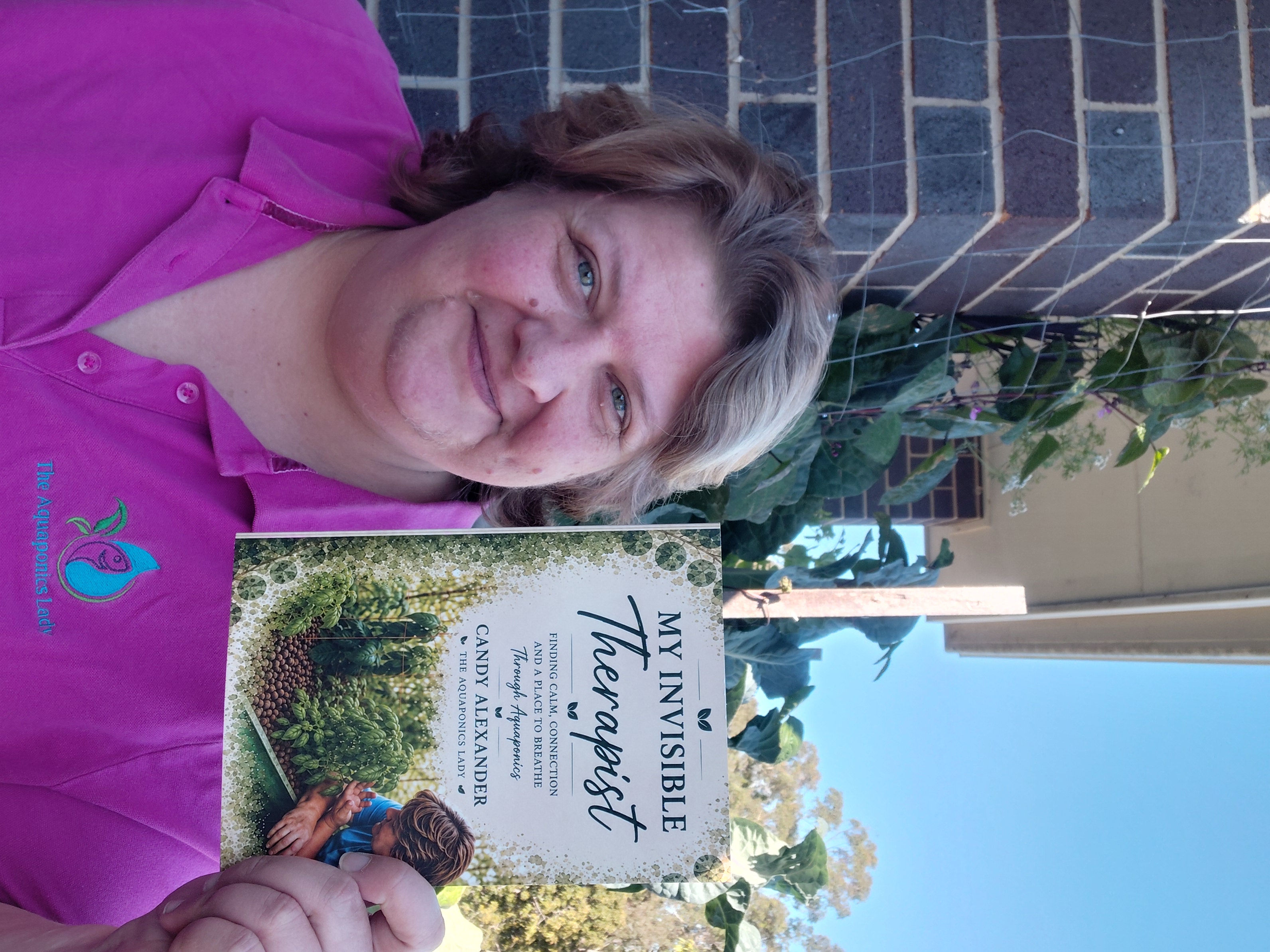
Why I Call Aquaponics My Invisible Therapist
Hi, I'm Candy — The Aquaponics Lady.
I have spent years teaching people about aquaponics, fish, water quality and the importance of understanding the ecosystem we're creating.
But aquaponics taught me too.
It taught me that mistakes aren't necessarily failures.
That balance doesn't mean everything stays the same.
That trying to control everything can sometimes make things harder.
That growth takes time.
And that sometimes we need to work with what is happening rather than constantly fighting against it.
I started aquaponics because I wanted to grow healthy food.
I never expected it to help me understand myself.
That's why I call it my invisible therapist.
Read My Story
My Invisible Therapist is the story of an unexpected relationship between aquaponics and one of the hardest periods of my life.
It's about growing food.
Caring for fish.
Learning from failure.
Finding purpose.
Understanding myself.
And discovering that sometimes healing and growth can appear in places we never thought to look.
My Invisible Therapist
Finding Calm, Connection and a Place to Breathe Through Aquaponics
Digital Book · $7 USD · Instant Access
By Candy Alexander — The Aquaponics Lady
Explore the Connection Between Aquaponics and Wellbeing
My Invisible Therapist tells the story of what aquaponics became for me.
But the connection between nature, growing food, caring for living things and the way we feel is something I continue to explore.
Garden Therapy brings together that quieter side of aquaponics — the water, the fish, the plants, the sensory experience and the simple act of having somewhere living to care for.
Sometimes Healing Grows in Water and Green Things
I started with a simple dream.
Grow healthy food.
Become more self-sufficient.
Build something that worked.
I couldn't have known where that decision would eventually take me.
My Invisible Therapist is the story of that journey — the failures, the lessons, the food, the fish, the difficult days and the unexpected ways aquaponics helped me find my way forward.
Digital Book · $7 USD · Instant Access
Copyright 2026 | Candy The Aquaponics Lady | All Rights Reserved Email: [email protected]
Youtube
Facebook
Instagram
LinkedIn
TikTok